The Rhedonian — A New Research Site Dedicated to the Mysteries of the Two Rennes
THE RIGGED DECK AND THE ARCHIVE UNDERWORLD
That effect was not merely to prove a Merovingian bloodline. It was to redirect attention, control interpretation, create symbolic authority, and perhaps to transform a much older Rennes-les-Bains landscape problem into a dynastic and esoteric paper-theatre. The central argument may be put simply: The Priory documents were probably false as history, but not empty as evidence. Their falsity may preserve traces of the archive-world from which they were assembled.
Plantard before Rennes: the making of a paper-order personality
Pierre Plantard did not begin with Rennes-le-Château. By the early 1940s he was already involved in small chivalric, political-esoteric, and youth-order structures. The journal Vaincre, organ of Alpha Galates, was published in 1942–1943 under the editorial name “Pierre de France” or “Pierre de France-Plantard,” and carried the subtitle Pour une jeune chevalerie. IAPSOP describes it as the journal of Alpha Galates, running for only six issues from September 1942 to February 1943.
Many later Priory themes are already visible in embryo: chivalry, youth, hidden order, national renewal, symbolic hierarchy, and the use of publications to create authority. Plantard was already learning how to make an organisation exist through paper.
The Au Pilori episode then adds a darker layer. On 19 November 1942, the pro-Nazi magazine Au Pilori attacked Plantard, Alpha Galates and Vaincre; the next issue of Vaincre was devoted to replying to that attack. This has often been used to suggest that Plantard cannot have been straightforwardly aligned with collaborationist anti-Masonic forces. That may be partly true. But the episode also shows something else: Plantard was already operating in a world of denunciation, counter-publication, masks, leaks, and defensive myth-making. In other words, before Rennes there was already a Plantardian method: create a small order, issue a paper organ, adopt grand language, attract attack, reply through publication, and transform vulnerability into symbolic importance.
Vichy, Coston, and the archive as weapon
John Saul’s suggestion that Plantard may have encountered material from confiscated Masonic archives is speculative, but it is not absurd. The historical background is real. Under Vichy, Masonic lodges were closed, archives seized, and anti-Masonic documentation services established.
A history of the Grande Loge de France records that its premises were sacked and that the anti-Mason Henry Coston installed his Centre d’action et de documentation there. Another account of Vichy anti-Masonic repression lists several anti-Masonic services operating in Paris, including Bernard Faÿ’s service and Coston’s CAD. At Faÿ’s postwar trial, he described his mission as searching for Masonic archives and recovering documents and lodge ornaments.
So the archive-reservoir existed. It would have contained names, correspondence, lodge lists, ritual material, rite histories, affiliations, internal disputes, and material from esoteric or fringe currents. Such files could serve repression, propaganda, blackmail, and myth-making.
The important point is not that Plantard definitely stole from Coston’s CAD. That remains unproven. The important point is that the Rennes/Priory world repeatedly behaves as if
documents are treasure.
The central objects are papers: Vaincre, Circuit, Lobineau, Blancassal, Alpina pamphlets, Saunière’s parchments, Marie de Nègre’s headstone, Boudet’s book and map, Chérisey’s codes, Sandri’s “coded” publications, and the vanished briefcase of Fakhar Ul Islam. This suggests a wider culture of archival predation: documents seized, leaked, forged, copied, stolen, re-attributed, and used as weapons.
L’Avenir du Chablais: Plantard’s Masonic apprenticeship and expulsion
Plantard’s brief Masonic episode at L’Avenir du Chablais is crucial. The lodge’s own history states that it initiated Pierre Plantard in July 1951, struck him off less than three years later, and that he later drew inspiration from this Masonic experience when founding the Priory of Sion. This does not mean that L’Avenir du Chablais transmitted a Rennes secret to him. The stronger argument is subtler: the lodge gave Plantard a lived experience of initiatory form — statutes, grades, officers, ritual, archives, discipline, exclusion, and symbolic authority.
After expulsion from a real Masonic lodge, Plantard creates his own substitute order. The Priory of Sion may therefore be understood, at least partly, as a paper replacement for lost initiatory legitimacy. This also helps explain the later Swiss-Masonic atmosphere. L’Avenir du Chablais belonged to the Chablais–Geneva–Annemasse borderland. Its own history links Chablais Freemasonry with Geneva’s La Fraternité and Annecy’s L’Allobrogie. The later use of Alpina, Geneva, Schidlof, Lobineau, and Swiss-Masonic hints may therefore be an inflated version of a real borderland experience.
The point is not that Alpina was truly behind the affair. The point is that Plantard had enough contact with Masonic-border culture to know how useful a Swiss-Masonic mask could be.
The Savoyard-Viennois Corridor: Chablais, La Tour-du-Pin, Vienne and Dynastic Myth
Plantard’s brief Masonic experience at L’Avenir du Chablais should not be isolated from its geographical setting. The lodge belonged to the Franco-Swiss borderland of Chablais, Geneva, Ambilly, Annemasse and Lake Léman. That region was not neutral territory in symbolic terms. It lay within the historical orbit of Savoy, Burgundy, Dauphiné, Vienne and the Alpine passes — a zone where dynastic legitimacy, regional identity, Roman Empire memory and borderland politics had long overlapped.
In fact the lodge that evicted Plantard had its origins in the French Revolution tumult, succeeding a first Lodge founded in the mid-1750s. At the very end of the 19th century, the Freemasons of the Chablais had the choice between going to Geneva or Annecy, where lodges of the Grand Orient de France had long been located, respectively La Fraternité (1798) and L'Allobrogie (1861).
The L'Allobrogie name comes from this context - supporters of the House of Savoy fled - and Paris-based Savoyard pressure groups supporting French intervention formally declared the annexation of Savoy to France. This pivotal moment marked the initial, short-lived, incorporation of the Duchy into the French Republic during the French Revolutionary Wars. Savoyard exiles and radicals in Paris formed the "Allobroges," advocating for revolutionary France to occupy Savoy.
The House of Savoy
The origins of this dynasty are unknown, but an early ancestor is Humbert, and his ancestors are variously said to have come from Saxony, Burgundy or Provence. Given Humbert's close connections with Rudolf III of Burgundy, it is likely that his family was Burgundian, and was descended either from the dukes of Vienne, or from a Burgundian aristocratic family (such as the Guigonids, ancestors of the counts of Albon).
The earliest rulers of Vienne and the Viennois region, were primarily acting as key, often contentious, vassals in Provence and Burgundy during the 9th–11th centuries before the county was granted to the Archdiocese of Vienne in 1023. Key figures include Girart de Roussillon, Boso of Provence, Hugh of Arles, and the long-ruling Charles-Constantine. These rulers of Vienne had their seat at Vienne, during the period of the Carolingian Empire and after until 1030, when the county of Vienne was granted to the Archdiocese of Vienne. Girart de Roussillon, a Frankish Burgundian leader who became Count of Paris in 837, and embraced the cause of Lothair I against Charles the Bald. He was a son of Leuthard I, Count of Fézensac and Paris, and his wife Grimildis. Girart de Roussillon is an epic figure in the cycle of Carolingian romances, collectively known as the Matter of France.
Vienne is a town in southeastern France, located 22 miles south of Lyon, at the confluence of the Gère and the Rhône. It is the fourth-largest commune in the Isère department, of which it is a subprefecture alongside La Tour-du-Pin. Vienne was a major centre of the Roman Empire under the Latin name Vienne. Vienne was the capital of the Allobroges, a Gallic people, before its conquest by the Romans. Transformed into a Roman colony in 47 BC under Julius Caesar, it became a major urban centre, ideally located along the Rhône, then a major axis of communication. Emperor Augustus banished Herod the Great's son, the ethnarch Herod Archelaus to Vienne in 6 AD. As Vienne was a Roman provincial capital, remains of Roman constructions are still widespread across it. The city was also an important early bishopric in Christian Gaul. Its most famous bishop was Avitus of Vienne. At the Council of Vienne, which was convened there in October 1311, Pope Clement V abolished the order of the Knights Templar. During the Middle Ages, Vienne was part of the Kingdom of Provence, part of the Holy Roman Empire; on the opposite bank of the Rhône was Kingdom of France, which made the city strategically important.
Humbert I “the Whitehanded” is another recognised founder of the house of Savoy, holding Savoy and lands east of the Rhône and south of Lake Geneva, and notes that he was probably of Burgundian origin. This is already significant for the Priory context, because Savoy represents exactly the kind of historical material Plantard later favoured: obscure origins, borderland authority, dynastic expansion, and the transformation of regional power into European significance.
The Dauphiné adds a second layer. The title Dauphin, later attached to the heir to the French throne, first belonged to the ruling house of Viennois. Britannica notes that the domain passed from the house of Albon to Burgundy in 1162 and then to the La Tour-du-Pin family in 1282; by the end of the thirteenth century, “Dauphin” had become the traditional title of the ruling house, and the territory became known as the Dauphiné. Thus, La Tour-du-Pin stands at a crucial dynastic hinge: a regional title of the Viennois/Dauphiné was eventually absorbed into the symbolism of French royal succession.
For a Rennes/Priory reading, this is highly suggestive. The La Tour-du-Pin family does not need to possess a secret Rennes tradition in order to matter. Its significance lies in the pattern it embodies: a local or borderland lineage carrying a title that later becomes royal. That is precisely the kind of transformation the Priory mythology repeatedly attempts. It takes local, obscure or ambiguous material and converts it into royal, initiatic or national significance.
We remember that Chérisey, at the centre of his grammar in CIRCUIT stands the pierre de Trou — literally, the “stone hole,” or “hole stone” but in Boudet’s hands much more than that. It is a polished stone, a so-called Celtic axe, a stone of belief, a thunderstone, a funerary object, and perhaps even a localised version of the heavenly stone. Plantard raises this stone onto a chimney and transforms it into the mitre of the Fool/Bishop. Chérisey lowers it again into the ground, into the orifice beneath the Pierre du Trou, Pierre du Pain, Pierre du Pin. We have noted elsewhere on this site that the key operation being hinted at is simple: turning. Turn the word. Turn the map. Turn the zodiac. Turn the circuit. The name La Tour-du-Pin is linguistically resonant in a Chérisey context. Historically, it means something close to “the tower of the pine,” but in the punning world of Circuit the name opens into a cluster of associations: tour as tower, turn, circuit; pin as pine, point or peg; pain as bread; pierre as stone; pieu or poteau as post or upright marker.
This does not prove historical connection, but it makes the name symbolically fertile. It belongs to the same poetic register as Chérisey’s transformations of stone, post, bread, card, map and sign.
The deeper historical resonance lies in Vienne. Ancient Vienna in Gaul was a major Roman city, and Herod Archelaus, son of Herod the Great, was exiled there by Augustus in 6 CE after complaints from Judaea and Samaria; after his removal, Judaea became a Roman province. In symbolic terms, this creates a striking precedent: a displaced Herodian ruler, tied to the Romanisation of Judaea, is sent into Gaul. For Rhedonian purposes this does not prove any Rennes-les-Bains burial theory, but it does provide a powerful historical echo: Roman-Judaean authority was once physically displaced into the Gallic world.
Vienne also later became the site of the council at which the Templar question was settled under Pope Clement V. The Council of Vienne, held in 1311–1312, is remembered above all for the suppression of the Templar order by the bull Vox in excelso. In the symbolic economy of the Priory myth, this matters because Vienne gathers together several themes later exploited by Rennes writers: Rome, Gaul, Herodian exile, Templar suppression, Burgundy-Provence, and dynastic legitimacy.
This makes the Chablais lodge-world more important than it first appears. Plantard was not merely initiated into an ordinary local association. He briefly entered a Masonic structure situated within a region saturated with borderland memory: Savoy, Geneva, Vienne, Burgundy, Dauphiné, Alpine passage, republican regionalism and old dynastic title. When he was later struck off from that world, the Priory of Sion may have functioned as a symbolic replacement — a paper-order that inflated the forms of initiation, title, archive and succession into a grander myth.
The Savoyard-Viennois corridor also helps explain why the later Priory apparatus so easily adopted Swiss and Masonic-looking masks. Alpina, Geneva, Schidlof, Lobineau and the Swiss documentary aura did not arise from nowhere. They belonged to the same imaginative geography as Plantard’s earlier Chablais experience: a borderland where France, Switzerland, Savoy, Masonry and archival authority could be made to overlap.
Plantard may also have picked up on the name of the Lodge and his eviction from L’Avenir du Chablais much more symbolically loaded than it first appears. He was not merely expelled from “a lodge.” He was expelled from a lodge rooted in a Savoyard–Genevan–Allobrogian border world: Thonon, Geneva, Annecy, Chablais, Lake Léman, Ambilly, Annemasse. The lodge’s own history says it succeeded earlier Masonic activity at Thonon, including La Bienfaisance in 1800; that Chablais Freemasons later worked through Geneva’s La Fraternité and Annecy’s L’Allobrogie; and that L’Avenir du Chablais itself was formally constituted in 1900 before moving to Ambilly in 1949, where it initiated Plantard in July 1951 and struck him off less than three years later.
Plantard may not have known some kind of ancient Savoyard secret. But it does show that the real institutional world he touched was already full of the things he later inflated: borderlands, lodges, initiations, Swiss proximity, republican myth, historical identity, old regional names, and vanished archives.
The Allobroges point is especially interesting. L’Allobrogie was an Annecy lodge name, but the term carries an older Savoyard/Rhône-Alpes identity. It reaches backwards to the ancient Gallic people of the Rhône-Alpine region and then forwards into revolutionary Savoyard identity. So even before Plantard invents or inflates the Priory, he has passed through a Masonic environment where ancient tribal names, regional identity, and political symbolism already belong together.
Vienne is not just another Roman town. It was ancient Vienna in Gaul, a major Roman city in the Rhône corridor. It is also where Herod Archelaus, son of Herod the Great, was exiled in 6 CE after Augustus removed him from rule over Judaea, Samaria and Idumaea. Livius summarises the sequence clearly: Archelaus ruled so badly that Jews and Samaritans appealed to Rome; Augustus deposed him; he was banished to Vienna in Gaul; and Judaea then became a Roman province.
It means that the Roman-Judaean rupture was literally displaced into Gaul.
Not Rennes-les-Bains, no — but Gaul. The Rhône world. Vienne. A Roman provincial city. A place tied to Herodian exile, Roman authority, and the aftermath of Judaea’s annexation.
The House of Savoy and the La Tour-du-Pin/Dauphiné material do not prove a hidden Priory tradition. Their importance is structural. They show that Plantard’s pre-Rennes world was already embedded in a region where local lineages, borderland politics, Roman memory, dynastic transfer and symbolic titles could be made to carry enormous mythic weight.
In this sense, Savoy is not the “answer” to Rennes. It is part of the machinery by which Plantard could imagine answers: a real historical corridor through which titles, bodies, borders and legitimacy had long moved.
Gisors as rehearsal: the hidden archive before Rennes
The Rennes affair did not appear immediately after the 1956 Priory. Gisors came first. Gérard de Sède’s Les Templiers sont parmi nous was published in 1962 and developed around Roger Lhomoy’s claim of a hidden Templar crypt beneath the Château de Gisors. Later summaries of the Gisors legend describe the hidden chamber, coffers, sarcophagi, collapse, and the failed official excavations of 1964. This matters because Gisors already contains the later Rennes formula: hidden chamber, secret order, buried archive, ambiguous witness, Templar aura, impossible verification, and Plantardian intervention.
The famous Canopus passage in de Sède’s Gisors book is especially important. De Santillana and von Dechend, in Hamlet’s Mill, explicitly wondered where Plantard obtained the information about “Canopus, l’œil sublime de l’architecte, qui s’ouvre tous les 70 ans pour contempler l’Univers.” That question remains revealing.
Plantard’s material sometimes contains obscure symbolic references that look less like ordinary invention and more like fragments drawn from specialised esoteric, Masonic, or antiquarian sources.
Gisors, therefore, may have been the first great test of Plantard’s method: attach a paper-order to a charged place and make hidden history appear to emerge from underground.
Rennes was the perfected version.
Lobineau as rigged deck
The Dossiers secrets d’Henri Lobineau are central to the later Priory myth. The BnF authority notice for Plantard is blunt: it identifies him as the inventor of the Priory of Sion in 1956 and as author, with Philippe de Chérisey, of the documents gathered under the title Dossiers secrets d’Henri Lobineau. The bibliographic mask, however, presents the dossier under “Henri Lobineau” and “P. Toscan du Plantier.”
That difference between surface attribution and attributed authorship is the trick.
The Lobineau material is not a normal authored work. It is a prepared dossier: pseudonyms, genealogies, historical fragments, inserted pages, corrections, masks, deposits, and displacement. The Rennes-le-Château Archive describes the dossiers as typed documents, some dated 1956, supposedly elaborated by Plantard and Chérisey and deposited anonymously at the Bibliothèque Nationale between 1964 and 1967.
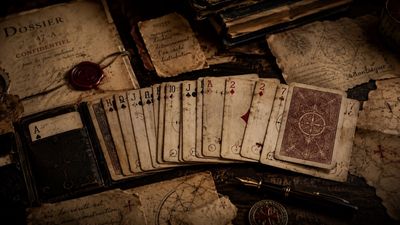
This is why Chérisey’s image of the jeu de cartes truqué — the rigged deck — is so apt.
A rigged deck is not made from imaginary cards. It is made from real cards that have been marked, stacked, or prepared so that the spectator’s “choice” has already been determined. In documentary form, Lobineau works the same way. It forces the reader from Rennes to Merovingians, from Merovingians to Dagobert II, from Dagobert to the Priory, and from the Priory toward Plantard.
The deck’s effect is to transform a difficult landscape problem into an apparently historical dynastic claim.
The “campaign” model: Sandri and the occult paper-war
Gino Sandri’s later statements should not be accepted uncritically. His claim to Priory proximity is itself part of the post-Plantard theatre. But his account is still useful because it describes the mechanism of the affair in exactly the terms the documents themselves suggest.
In his 2003 interview, Sandri says he was received into the Priory in 1977 on Plantard’s recommendation. The interviewer presents him as close to Plantard, while also warning that his arguments and insinuations are his responsibility alone. Sandri then says that certain publications were not intended for the general public but served as supports for coded exchanges between networks. Most importantly, he describes a “real campaign” aimed at a person or society acting in the occult field.
This supports the idea that the Priory documents may not have been merely public hoaxes. They may have functioned as operational documents: bait, warning, ridicule, accusation, signal, or diversion inside a restricted esoteric milieu. This does not prove that Sandri knew the original motive. But it confirms that at least one later Priory insider understood the dossier-world as a campaign of papers, codes, and rival networks.
Memphis-Misraïm, Chefdebien, Hautpoul, and the Rennes archive-corridor
The Memphis-Misraïm / Philadelphes / Chefdebien / Hautpoul material should be handled carefully. It is not a clean chain of proof. But it is an extremely important symbolic and documentary corridor.
The Rite of Memphis-Misraïm is historically associated with a fusion of the Rite of Misraïm and the Rite of Memphis, the latter founded by Jacques-Étienne Marconis de Nègre in 1838. Traditions around the Primitive Rite of Narbonne associate the Philadelphes of Narbonne with the Chefdebien family and with a late eighteenth-century esoteric Masonic current.
This matters for Rennes because the same field can be made to touch Narbonne, Hautpoul, Marie de Nègre d’Ablès, the missing headstone, Saunière’s parchments, and later Plantard-Chérisey codes. Whether or not every genealogical or initiatory link is solid, the structure is perfect for Priory use: noble families, occult rites, missing documents, Egypt, Templars, Narbonne, Nègre, Hautpoul, and Rennes.
The claim that Alfred Saunière was dismissed from the Chefdebien household after a suspected document theft is potentially explosive, but it must remain provisional until pinned to a primary source. If true, it would place the Saunière family directly into the same archive-theft pattern. But even as a motif, it reveals the logic of the affair: knowledge is imagined as something removed from a noble or occult archive and later reappearing in disguised form.
Le Serpent Rouge and the sealing of Rennes
Le Serpent Rouge is another prepared object. The BnF catalogue lists it as Le Serpent rouge: notes sur Saint-Germain-des-Prés et Saint-Sulpice de Paris, by Pierre Feugère, Louis Saint-Maxent and Gaston de Koker, published at Pontoise in 1967. The Rennes-le-Château Archive describes the text as the most important part of the Plantard dossier and notes its esoteric importance.
What matters for Rhedonian purposes is that Le Serpent Rouge does not simply point toward Rennes-le-Château. It also draws upon Boudet’s La Vraie Langue Celtique and the cromlech of Rennes-les-Bains. Boudet’s book itself is a genuine nineteenth-century object: the Royal Collection catalogue records the 1886 edition of La vraie langue celtique et le cromleck de Rennes-les-Bains. Thus, the Priory apparatus is not inventing the Rennes-les-Bains substrate. It is reusing it.
This is the crucial distinction.
Plantard and Chérisey may have rigged the deck, but they did not invent the table.
Rennes-les-Bains as the real table
Rennes-les-Bains belongs to a different order of evidence from Lobineau. The Lobineau/Priory layer is paper: genealogies, pseudonyms, deposits, secret societies, dynastic claims. Rennes-les-Bains is landscape: stones, water, inscriptions, cemetery, temple traditions, Boudet’s cromlech, Roc Nègre, the Devil’s Chair, and the Sals.
The Priory mythology converts this landscape into a dynastic theatre. Pompeius becomes a “Grand Roman.” The cemetery becomes a code-field. Boudet’s cromlech becomes a map of hidden meaning. Roman remains become the ground on which Merovingian legitimacy can be staged.
But the underlying questions are not inherently Merovingian. They are older and stranger:
What was the Roman-sacred status of Rennes-les-Bains?
Why did Boudet construct such a peculiar sacred geography around it?
Why does the myth keep returning to burial, stone, source, cemetery, and hidden body?
Why does Chérisey mock the documentary apparatus while still circling the terrain?
This is why the “rigged deck” metaphor matters. It allows us to separate false arrangement from real substrate.
Chérisey’s role: conjuror, exposer, or both?
Philippe de Chérisey is not merely a forger in this model. He is the writer who seems to understand the trick. In Circuit, the image of Fakhar Ul Islam with a rigged deck of cards turns the Priory archive into conjuring equipment. The courier becomes a magician. The hidden briefcase becomes vanished apparatus. The documents become trick cards.
That is not just comedy. It is a theory of the affair.
Chérisey’s puns — le grand Pompée / le grand pompé, les treize ors de l’Arène, l’Alibi d’O — do not simply destroy the myth. They reveal how the myth is made. He shows the mechanism while still keeping the reader inside it. In that sense, Chérisey may be both conjuror and exposer. He helps rig the deck, but he also teaches us to see that it is rigged.
The strongest form of the argument
The argument can now be stated in seven propositions.
- First, Plantard’s method predates Rennes. Alpha Galates, Vaincre, youth chivalry, order-language, pseudonyms, and defensive publication already exist in the 1940s.
- Second, Vichy’s anti-Masonic archive seizures created a real documentary underworld in which Masonic and occult papers could be seized, copied, weaponised, leaked, or recycled.
- Third, Plantard’s brief membership and expulsion from L’Avenir du Chablais gave him a lived model of initiatory authority and perhaps helped produce the later Swiss-Masonic atmosphere of the Priory myth.
- Fourth, Gisors was the rehearsal: a hidden underground archive/treasure narrative attached to Templars, secret history, and Plantardian symbolism.
- Fifth, Lobineau was the rigged deck: a prepared documentary packet arranged to make Plantard’s dynastic myth appear archival.
- Sixth, Memphis-Misraïm, Chefdebien, Hautpoul, Nègre, Boudet, and Le Cour-like materials provided a reservoir of names and traditions from which the Priory myth could draw.
- Seventh, Rennes-les-Bains is the table beneath the deck: not proof of the Priory claims, but the older landscape-substrate that the Priory system attempted to appropriate, distort, and seal into its own mythology.
Conclusion
The best academic formulation may be this: the Priory of Sion affair was not merely a hoax, but an act of archival construction. Plantard and his collaborators appear to have assembled a false order from real fragments: Masonic forms, occult names, confiscated or circulating archive-material, esoteric publications, noble genealogies, local Rennes traditions, and Boudet’s Rennes-les-Bains landscape. The resulting dossier was a rigged deck: not wholly imaginary, but dishonestly arranged. Its purpose was to force the reader towards Plantardian legitimacy while obscuring the older and more difficult question of Rennes-les-Bains itself.
And the final Rhedonian point: The cards may be false, but the table is real.
The task, therefore, is not to believe the deck. Nor is it to throw away the table because the deck is rigged. The task is to remove the cards carefully and examine what they were laid upon.