The Rhedonian — A New Research Site Dedicated to the Mysteries of the Two Rennes
THE CIRCUS OF SION
This article examines a comic, intoxicated, and densely allusive chapter in which the Rennes-les-Bains myth is presented as circus, conjuring act, puppet-show, and funerary riddle. At first glance, the text appears to be a chaotic burlesque of Rennes mythology: Dagobert, the Priory of Sion, Pompeius Quartus, Roc Nègre, the Devil’s Armchair, the shepherdess, the zero meridian, Nostradamus, Delmas, and a lost pagan temple all thrown together in a drunken dialogue. Yet beneath this theatrical disorder lies a precise commentary on how the Rennes myth was constructed. The passage does not simply invent; it stages the process of the invention. It shows how a real or reputed archaeological and funerary substratum at Rennes-les-Bains could be inflated into a grand symbolic drama involving Rome, Merovingian genealogy, secret societies, Masonic burial symbolism, meridian geometry, and prophetic wordplay. For a Rhedonian reading, the passage is therefore not reliable as literal history, but highly valuable as a map of myth-making.
The chapter comes from the Chérisey novel, CIRCUIT. The passage opens with the comic song of “Le bon roi Dagobert”, but this apparently light-hearted beginning immediately establishes one of the principal themes of the text: crooked kingship. Dagobert, having become drunk, walks de travers — walks crookedly, sideways, wrongly. Saint Eloi [or Saint Eligius, a Frankish goldsmith, courtier, and bishop who was chief counsellor to Dagobert Iand later Bishop of Noyon–Tournai. His deeds were recorded in Vita Sancti Eligii, written by his friend Audoin of Rouen] corrects him, only for the king to reply that no one walks straight when drunk. The joke is simple, but its symbolic force is considerable. In French, droit means not only straight, but also right, lawful, legitimate. The drunken king cannot walk straight; by implication, royal legitimacy itself has become unstable.
This is relevant because a King Dagobert [to be precise, Dagobert II] occupies a privileged place in the Priory of Sion and Rennes-le-Château mythos. He is not merely portrayed as a comic king from a nursery song; he is part of the Merovingian genealogical theatre through which Plantardian mythology sought to construct descent, legitimacy, and hidden royal continuity. The text, however, refuses solemnity. It begins by making Dagobert ridiculous. Kingship is already intoxicated. Genealogy is already crooked. The royal line moves sideways. This opening prepares the later claim that Dagobert’s famous reversed clothing — his culotte à l’envers — signifies a tampered genealogy. The folk-song image of the king dressed incorrectly becomes, in this passage, a cipher for dynastic falsification. The text therefore converts comic reversal into genealogical suspicion. A king walking crookedly becomes a royal line that may not be straight.
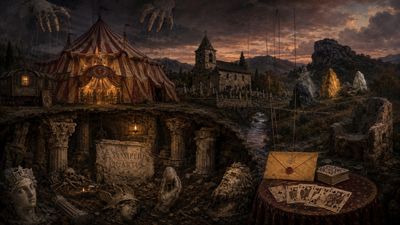
Next Critias is introduced who places a large yellow envelope on the table. The envelope is crucial. It is the object of transmission, the document-container, the portable archive. In the Rennes tradition, revelation often arrives in this form: through envelopes, dossiers, parchments, letters, private communications, lost reports, and documents of uncertain authority. The yellow envelope is therefore not an incidental prop. It is the material sign of the mystery’s documentary theatre.
The person who gives this envelope to Critias is “General David-Leroy.” Even this name may not be innocent. Heard phonetically, David-Leroy approaches David le Roi — David the King, King David of David and Solomon fame. Whether deliberate or not, the name suits the passage’s larger atmosphere of biblical kingship, royal descent, and theatrical authority. This military-sounding figure gives a document to be transmitted to Anne and Charlot. Authority is staged through rank, name, and chain of custody.
Critias, in literal historical terms, was an influential Athenian political leader, poet, and philosopher, best known as the leader of the brutal "Thirty Tyrants" oligarchy in 404/403 BCE. He was a student of Socrates and a relative of Plato, and he was known for his extreme anti-democratic views. He is also featured as a character in Plato’s dialogues Timaeus and Critias, a speech between the two which discusses cosmological speculations about a World Soul, the creation of the earth and the heavenly spheres, the created gods, man, and finally animals and also about the myth of Atlantis and an earlier golden age of Athens.
Chérisey introduces Critias as a performer. He removes a curious hat, releasing a fiery head of hair, places the hat on the table, and points his finger at Anne and Charlot. The hat evokes conjuring. Something hidden is released. The index finger points, directs, accuses, and indicates. In a text obsessed with alignments, directions, rocks, meridians, and hidden objects, the pointing finger is itself a sign of interpretation.
When Critias says, “Listen, Socrates, to an admirable and true story,” the Platonic allusion is unmistakable. Critias and Socrates belong to the world of Plato’s Timaeus and Critias, where the Atlantis narrative is presented as ancient, transmitted, impressive, and possibly true. This is an important literary signal. The Rennes story is being placed in the same ambiguous category as Atlantis: a grand ancient narrative offered as truth, but hovering between history, myth, allegory, and invention.
Anne’s later reply to discussions deepens any ambiguity:
“The flesh, beware Jakin, leaves the bones.”
Jakin, or Jachin, is one of the two pillars of Solomon’s Temple; Boaz, named immediately afterwards, is the other. Here, however, temple symbolism is joined to bodily decomposition. Flesh leaves bones; everything comes apart. The pillars of sacred architecture become associated with death, dismemberment, and the exposed skeleton. This is one of the first signs that the passage is not merely comic. Temple and body are being fused. Architecture becomes anatomy. The sacred site becomes a corpse.
Charlot’s obscene offer of his medius — his middle finger — parodies ritual recognition and perhaps Masonic handshakes. Sacred signs are continually degraded into comic gestures. Yet the degradation does not empty them of meaning. Rather, it demonstrates the method of the passage: solemn esoteric language is invoked, mocked, and still used.
Critias describes his desertion from the Salvation Army, his weariness at declaiming Homer and Virgil before a tripod at Christmas, piping before a cauldron, and collecting the obol of the wretched. This is a condensed image of syncretism. Homer and Virgil represent the classical epic; the tripod evokes Delphi and pagan prophecy; Christmas brings in Christian sacred time; the cauldron suggests Celtic or magical transformation; the obol is both a coin of charity and the funerary coin of Charon. Religion, theatre, classical learning, prophecy, charity, and death are all made to occupy the same stage.
This matters here at Rhedonian because our reading of Rennes-les-Bains is of a repeatedly constructed syncretic nature precisely as described above. The local Rennes landscape becomes Roman, Celtic, Christian, Masonic, Merovingian, and prophetic all at once. The passage does not merely contain confusion; it dramatises the process by which different symbolic systems are laid over one another.
For example the appearance of Jean Valjean from a Paris sewer continues a descent motif. The secret does not emerge from a holy crypt, but from an urban drain. Valjean, the great figure of Les Misérables, rises from below as “son of putrefaction.” The underground world is thus not romanticised. It is sewer, rot, corpse, and theatre. Rennes mythology often depends on caves, mines, wells, crypts, and underground passages; here that entire subterranean imagination is displaced into farce. Jean Valjean then appears “in the role of Marc Benahim,” and announces that his career as an actor is ending and his career as impresario [from the Italian word impresa, which means "an undertaking" or "enterprise"] of the Priory is beginning. This is one of the most revealing moments in the passage. The Priory of Sion is not presented as a venerable secret order, but as like a music-hall. Sion, in Valais, is turned into an entertainment venue “for big and small alike.” The sacred name Zion/Sion is demoted into theatre.
The description of the Priory’s personnel is especially significant: forty artists, twenty-seven on stage and thirteen backstage pulling the strings. The whole Rennes apparatus is thereby figured as a puppet-show. Some actors are visible; others are hidden. Some perform; others manipulate. The number thirteen recurs throughout the chapter: thirteen bottles, thirteen backstage operators, thirteen golds, thirteen years. It evokes the hidden extra element, the concealed thirteenth sign, the operator behind the visible zodiacal or symbolic order.
The murdered conjurer Fakhar Ul Islam, found on the Paris-Geneva railway line with a trick deck of cards in his pocket while all his equipment has vanished, functions almost as a miniature allegory of the Rennes affair. The trick remains, but the mechanism disappears. The cards are rigged, but the apparatus is gone. This recalls the wider problem of the Rennes archive: we are often left with effects, claims, hints, and symbolic residues, while the machinery that produced them has vanished or was deliberately concealed.
The next performance, Critias says, will be at Rennes-les-Bains, where the circus will pitch its chapiteau - a French word most commonly translating to big top (a circus tent) or a marquee. It can also mean a capital (as in the architectural top of a column. These columns are found in classical architecture and can be convex, as in the Doric order; concave like an inverted bell, as in the Corinthian order; or in a spiral, as in the Ionic order). This phrase is decisive. Rennes-les-Bains becomes a stage. Yet a stage is not necessarily empty. The question becomes: why is the circus pitched here? What is beneath the tent? Why draw attention to classical ancient architectural columns?
The answer is given in a topographically precise passage. The big top/circus is to be planted south of the village of Rennes-les-Bains, on the left bank of the Sals, beyond the cemetery, after the great square and the church. This is one of the most important sections of the text. Amid all the farce and theatricality, the passage suddenly fixes itself in a recognisable landscape: the church, the cemetery, the grand square, the left bank of the Sals, the southern zone of the village. This is very close to the archaeological and funerary cluster that our Rhedonian approach identifies as central to the whole enigma of Rennes-les-Bains.
Here, Critias says, stood a pagan temple fifteen metres high, burned by Charles Martel in 737 during his attempted invasion of Languedoc. The historical reliability of this claim is highly doubtful. It reads like legendary destruction-history: pagan temple, fire, Christian or Frankish violence, buried relics, sacred ruin. Yet the legendary form is itself revealing. The passage constructs Rennes-les-Bains as a destroyed sanctuary, a place where sacred architecture has been burned, buried, and fragmented. Here the chapiteau becomes relevant - in architectural terms it refers to any upper part of a column, pilaster or ante, flared in shape, supporting the entablature of a vault, and may have ornamental motifs. They can be Byzantine capitals, or composite, Corinthian, Romanesque; square, flared capitals; bronze capitals; or a folded capital (this crowns a pilaster placed at a retractable angle and follows the shape of two walls]. Cherisey is directing us to the history of a very important Temple in this valley, the same as Boudet did throughout his work.
The relics associated with this temple are equally significant: a statue of Isis, alias the Venus of Ille; heads of Mercury and Jupiter; an arm holding a cloth; a hand holding an egg; and a charnel-house beneath the great square [ie the Place Deux Rennes]. This is not the language of a simple treasure narrative. It is the language of a ruined cult-site and funerary landscape. The body is everywhere: heads, arm, hand, bones, charnel-house. Even the egg held in the hand suggests life, rebirth, offering, or ritual. Such imagery sits naturally within the idea of a healing or votive sanctuary, but uneasily within a purely financial treasure myth.
The reference to the “Memoirs of Abbé Delmas” then turns the passage into explicit methodological critique. These memoirs, Critias says, have caused far more saliva than ink to flow, and have been lost for more than a century. Did they ever exist? Do they still exist? The answer is a single word: Prestidigitation. This is not merely a joke. It is a warning. The text identifies a procedure central to the Rennes myth: drawing elaborate information from a vanished document whose existence, form, or contents can no longer be securely checked. A lost source becomes infinitely useful because it cannot answer back. It can be made to bear whatever weight the myth requires.
Yet this does not mean that all the underlying material is false. The passage is subtler than that. It mocks the use of Delmas as an unverifiable authority, but it does not choose an arbitrary setting. The conjuring act is staged over a particular archaeological zone. The likely Rhedonian conclusion is therefore not that the temple, funerary, or Roman material should be dismissed wholesale, but that it must be separated from the theatrical use made of it.
Anne and Charlot become too drunk to formulate their protest against such a methods. The passage notes that the procedure resembles their own investigation too closely: an inquiry made all the more fascinating because no one knows what it is really about. This is one of the sharpest observations in the entire text. Rennes research often becomes compelling precisely because its object remains unstable. Is the mystery a treasure, a tomb, a genealogy, a church secret, a Roman survival, a Merovingian claim, a literary hoax, an archaeological memory, or an occult map? The uncertainty generates the fascination.
The Canaries and the zero meridian introduce the next stage of symbolic inflation. The text mocks the necessity of travelling to the Canaries to hear about a zero meridian that passed through Paris near Anne’s home. This is a satire of over-extended symbolic geography. Rennes mythology repeatedly draws lines outward: Paris, Geneva, Sion, Ferro, Rome, Miletus, Arabia, the Canaries. The local site becomes a node in an enormous web of origin-lines. A zero meridian is not just a geographic line; it is an origin from which measurement begins. In the symbolic logic of the passage, meridians are geographical equivalents of genealogies.
Critias then announces that “Panem et circenses” will be the slogan of the circus. Rome enters again, this time as spectacle. The Rennes myth is presented as bread and circuses, a public entertainment that feeds and distracts. Charlot replies with the alliterative formula “Des frasques, des fresques, des frusques” — antics, frescoes, rags. History becomes escapade, image, and costume. This is an excellent description of Chérisey’s literary method: scandal, painted scenery, and disguise.
The appearance of “Le grand Pompée” is then immediately punctured by Anne’s reply: “Le grand pompé, c’est lui.” This pun is central. Pompée is Pompey; pompé means pumped, sucked up, copied, borrowed, inflated. The “Great Pompey” is also the “great pumped-up one.” In a single joke, the text exposes the transformation by which the modest funerary inscription of C. Pompeius Quartus can be inflated into Pompey the Great, the Grand Roman, a world-historical relic, and a buried secret of Rennes. The lowercase version (past participle of the verb pomper, meaning to pump) also has a vulgar slang meaning in French, equivalent to "getting blown" or "getting a handjob."
The subsequent Roman history is deliberately scrambled. Sertorius is placed on the island of Ferro; Pompey is buried at Rennes; the two establish a dialogue between zero meridians. The defeat at Naulochus by Agrippa actually belongs to Sextus Pompeius, not Pompey the Great. The death at Miletus likewise points towards Sextus rather than Pompey himself. The text fuses several Pompeian figures into one composite “Great Pompey.” This is not clean historical writing; it is mythographic condensation.
That condensation is precisely what matters. The Rennes myth does not preserve one simple Roman identity. It creates a symbolic Roman body from several fragments: Pompey the Great, Sextus Pompeius, Sertorius, Agrippa, Miletus, Naulochus, and finally C. Pompeius Quartus. The local inscription becomes the epigraphic seed from which a grand Roman myth is grown.
The story then becomes relic-translation. Milesian philosophers embalm the body; it becomes an object of veneration; Arabs seize the relic and deposit it at Rennes during the invasion of Languedoc; an inviolable tomb of marble and lead is made near Rocko-Negro. Historically, this is fantasy. Structurally, however, it is highly revealing. The passage turns a Roman political corpse into a sacred relic, transported across civilisations and finally deposited in Rennes-les-Bains. The local site is made to contain displaced Mediterranean history.
The phrase Rocko-Negro is itself theatrical. It points to Roc Nègre, but also sounds like a stage-name, a “rock” motif, and later connects with the passage’s play on rock’n’roll, rochers, and roulers. Roc Nègre becomes not merely a place-name but a symbolic black stone, a marker in the Priory landscape, and a possible axis of buried meaning.
The funerary plaque then appears: C. POMPEIUS QUARTUS D.M. SVO. This is the hard kernel inside the theatrical fruit. After the wild story of Pompey, Miletus, relics, Arabs, marble, lead, and Roc Nègre, the text suddenly offers an inscription. The trick is obvious: a real or reputed funerary object is used to validate an extravagant legend. Yet the inscription itself does not prove Pompey the Great, nor a transported relic, nor a marble tomb near Roc Nègre. What it does prove, or at least strongly indicates in the tradition, is a funerary Roman presence. The abbreviation D.M., Diis Manibus, belongs to the world of the dead.
This is crucial. The passage may be mocking the inflation of Pompeius into Pompey, but it also keeps returning to death: bones, ashes, tombs, charnel-houses, funerary inscriptions, relics, dust. The theatrical superstructure is unstable; the funerary substratum is persistent.
Critias then links D.M. to “the D.M. writing of Nostradamus,” drawing Roman epigraphy into prophetic code. This is another inflationary move. A standard funerary abbreviation becomes a cipher, then a Nostradamian sign, then part of the “Grand Roman” prophecy. The mechanism is clear: ordinary archaeological material is transformed into esoteric script.
The circus prospectus now displays the attractions. First comes the embrace of the Great Monarch with the Great Roman inside a circle of menhirs and under a Medusan sign. This scene fuses Boudet’s cromlech landscape, French royalist prophecy, Roman funerary myth, and Nostradamus. The “Medusan sign” evokes the serpentine, petrifying, monstrous emblem under which the Great Roman appears. Medusa turns life into stone; the Rennes landscape is a field of stones made to speak. The serpent, the stone, and the prophetic Roman are brought together in one tableau.
Next comes the devil seated on his stone throne, counting the treasure gathered over centuries. This evokes the Fauteuil du Diable, the Devil’s Armchair. Again, Boudet’s landscape is absorbed into the circus. The motto attached to this attraction is perhaps the most brilliant phonetic clue in the passage: “Les treize ors de l’Arène.” Heard aloud, les treize ors de l’Arène becomes le trésor de Rennes.
This is not accidental. It reveals the treasure as a phonetic construction inside the circus arena. “The thirteen golds of the Arena” becomes “the treasure of Rennes.” The pun also binds together several major motifs: thirteen, gold, arena, circus, Rennes, treasure. The treasure is not simply found; it is made through sound.
Finally there appears the hidden shepherdess, concealed in the alignment of three rocks: one black, one yellow and pointed, one white, corresponding respectively to Melchior, Balthazar, and Gaspard. This is a landscape riddle. The black rock naturally suggests Roc Nègre. The yellow pointed rock may suggest Roc Pointu or a golden/yellow marker. The white rock may evoke Blanchefort or another pale/white landmark, perhaps Cardou, perhaps Lampos. The three rocks are mapped onto the Three Magi, converting the local topography into an Epiphany [a Christian event celebrated on January 6th (or Jan 19th for some Orthodox churches), which marks the "manifestation" of God through Jesus to the world. Spiritually, it commemorates the Magi's visit (Gentile recognition), Jesus' baptism, and his first miracle]. Three kings, three rocks, one hidden feminine figure: the shepherdess is not merely a character, but the object of a geometrical and symbolic alignment.
At this point, Temperantia flees through the door. The allegory is perfect. Temperance, moderation, balance, and sobriety abandon the room. Rennes interpretation has become intoxicated with puns, relics, kings, meridians, stones, prophetic abbreviations, and hidden tombs. As Critias rises, she almost overturns the table, and the ashes from the ashtray scatter. The image returns the whole passage to death. Ashes recall cremation, destroyed temples, urns, burned sanctuaries, and human remains. Anne and Charlot complete the funeral formula: “For dust thou art, and unto dust shalt thou return.”
The arrival of nepenthe, which is only coffee, introduces forgetfulness. In Homer, nepenthe is the drug that relieves grief by erasing sorrow from memory. In this passage, the “nepenthe” refreshes memory and warms the body, but the allusion remains important. Rennes is a field of memory and forgetting: lost documents, altered genealogies, vanished relics, disturbed burials, and traditions half-preserved through rumour. The drink of forgetfulness is also the drink that allows the performance to continue.
The later passage on Dagobert’s sword returns to the theme of tampered genealogy. The king’s reversed breeches mean that his descent has been falsified. His sword passes through a female line and is later found in a violated burial on 17 January 1913, adorned with Merovingian bees, gold rectangles, and lunar cells. Whether or not any historical claim here is reliable [it is, photos of this sword exist], the symbolic structure is plain: violated tomb, Merovingian regalia, gold, bees, lunar time, dynastic transfer, and the charged date of 17 January. The burial has once again become the place where genealogy is hidden, broken, or recovered.
The remainder of the passage becomes increasingly erotic, dreamlike, and mythic, but it continues the same pattern. Bodies become landscapes; landscapes become bodies. Arms, neck, eyes, teeth, mouths, breasts, circles, crowns, rocks, wells, pendulums, royal treasure, caves, queenly citadels — all are mixed into a single bodily geography.
The lovers Anne and Charlot become part of a recurrent myth of pursuit: Arthur, Artus, Arcturus, the hunter and the doe, the circular earth, the impossibility of knowing who pursues and who flees. The Rennes landscape becomes a theatre of repetition, reversal, and reincarnated “first times.”
The line about looking at “la feuille à l’envers” — the leaf or sheet upside down — is especially suggestive. It recalls Dagobert’s reversed clothing and the general principle of inversion. In Rennes terms, this may suggest reverse-reading, mirror-reading, turning the map over, or reading the landscape from the other side. Chérisey’s method is full of such reversals. Meaning is rarely presented directly; it is turned, displaced, punning, or inverted.
The Pointe-à-Pitre passage continues the phonetic cascade. Pitre means clown; pointe means point; Pointe-à-Pitre becomes the point of a razor. Names are not stable referents but machines of sound. This places Chérisey close to, but also distinct from, Boudet. Boudet sought to make the landscape speak through eccentric philology; Chérisey turns that method into comic theatre. Boudet’s sacred etymology becomes Chérisey’s punning circus.
The final drowning of Critias while trying to save Temperance is a fitting conclusion. The teller of the “admirable and true story” disappears into water. The yellow envelope, destined for Anne and Charlot, is found at the shore. The document survives; the mediator vanishes. Sauveur hints darkly at the Cugulhou, “the devil.” The landscape has swallowed the storyteller, leaving behind only the envelope, the rumour, and the fearsome place-name. Like Atlantis, everything disappears under water.
This ending is deeply Rennes-like. The witness disappears. The document remains. The explanation is interrupted. A local topographical name is made diabolical. The mystery survives through absence.
For Rhedonian, the importance of this chapter lies in its double movement. On one hand, it relentlessly exposes the Priory/Rennes myth as theatre: circus, music-hall, puppet-show, conjuring, rigged cards, vanished apparatus, promotional prospectus, drunken speech, and puns. On the other hand, it does not invent its stage from nothing. It repeatedly anchors the performance in Rennes-les-Bains as a specific sacred and funerary landscape: left bank of the Sals, church, cemetery, great square, pagan temple, statuary fragments, votive body-parts, charnel-house, Pompeius inscription, Roc Nègre, Devil’s Chair, Cugulhou, and the alignment of rocks.
This is why the chapter should not be read either as evidence or as mere nonsense. It is better understood as a text about the making of the Rennes myth. It shows how a local Roman funerary inscription can be pumped into Pompey; how a standard epigraphic formula can become prophetic code; how a lost antiquarian source can become conjuring apparatus; how Boudet’s cromlech can become a circus ring; how the Devil’s Armchair can become a treasure attraction; how les treize ors de l’Arène can become le trésor de Rennes; and how the archaeological memory of a sacred/funerary zone can be transformed into a grand symbolic drama of Rome, Merovingians, meridians, and hidden tombs.
The most useful Rhedonian conclusion is therefore not that the passage tells us what happened at Rennes-les-Bains. It does not. Rather, it tells us how Rennes-les-Bains was made to mean. It reveals the transformation of archaeology into theatre.
It exposes the inflation of Pompeius Quartus into the Grand Roman. It mocks the Priory while preserving the logic of its construction. It warns against vanished documents while pointing back to a real topographical cluster. Most importantly, it confirms that beneath the theatrical treasure-story lies a more persistent and older motif: burial.
The treasure may be circus.
The Priory may be puppet-show.
The documents may be conjuring.
But the repeated return to ashes, bones, tombs, charnel remains, funerary inscriptions, violated graves, relics, and dust suggests that the deeper imaginative centre of the Rennes-les-Bains myth is not gold. It is the dead.
And that is precisely where a Rhedonian reading begins.